
Kimberly Reinhold, PhD
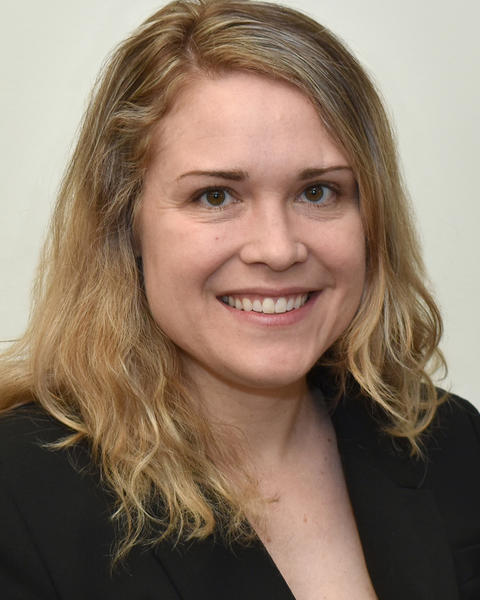
Kimberley Reinhold, PhD, is an investigator in the Eaton-Peabody Laboratories at Mass Eye and Ear. Her mission is to transform mental health by understanding how the sensory world steers the mind. As individuals experience the sensory world, they learn to respond to meaningful cues while filtering out the irrelevant. Dr. Reinhold's lab investigates how these sensory experiences become linked to adaptive or maladaptive responses through learning. A major challenge in this area is that a single sensory cue can activate many overlapping and diverging pathways across the brain, making it difficult to precisely trace how behavior emerges from these circuits.
To cut through this complexity, Dr. Reinhold's team has developed an innovative approach: training mice to respond to a synthetic cue—optogenetic activation of neurons in the sensory cortex. In essence, the lab “plays” a sensory cue directly into the brain using light. This strategy bypasses some of the brain’s inherent complexity, allowing the team to trace the flow of activity through specific neural pathways with unprecedented clarity. Remarkably, the mice learn to respond to this synthetic cue as if it were a real sensation. This powerful approach enables Dr. Reinhold's lab to precisely probe the cue-to-response pathway and uncover how neural circuits and synapses change as learning unfolds.
Her work to understand the brain mechanisms that support associative auditory cue-to-response learning aims to advance mental health in multiple ways. This understanding will be crucial for developing therapeutic strategies to (a) promote beneficial associations, such as faster and improved use of assistive devices, and (b) weaken detrimental associations, as in tinnitus and hyperacusis. Dr. Reinhold's long-term goal is to harness the brain’s own learning machinery to speed up learning and reverse the pathological changes underlying auditory disorders.
Dr. Reinhold earned her undergraduate degree in brain and cognitive sciences at the Massachusetts Institute of Technology, followed by a PhD in neuroscience at the University of California, San Diego. She then completed postgraduate training in neurobiology at Harvard Medical School.